Maintenance workflows
How to handle tenant repair requests: a practical workflow
Build a clear tenant repair request process from first report to resolution, with better intake, next actions, updates, and records.

A tenant repair request is rarely difficult because the first message is hard to understand. The difficulty appears later: the request lacks a photo, the next step is unclear, a contractor is waiting for access, or the tenant does not know whether anything is happening.
A useful repair process makes the next action visible to everyone who needs it. It does not have to replace your accounting, leasing, or asset-management systems. It needs to give repair communication a reliable home. That is the role of focused property manager communication software.
1. Capture enough information at the start
The first report should answer a small set of operational questions:
- What is wrong?
- Where is the problem: building, shared area, or residential unit?
- When did it start?
- Is there an immediate safety or damage risk?
- Can the tenant provide a useful photo or video?
- Are there access constraints or suitable appointment times?
Do not turn the intake form into an inspection report. Ask only for information that changes the first decision. A clear title such as “Water leaking below kitchen sink” is more useful than “Help needed,” but the tenant should not have to diagnose the plumbing.
2. Separate urgency from inconvenience
Priority should describe the response required, not how strongly someone phrases the message. A simple internal policy might use four levels:
| Priority | Working definition | Typical first action |
|---|---|---|
| Critical | Immediate danger, major active damage, or essential access failure | Escalate now and give safety instructions |
| High | Serious issue that can worsen quickly or significantly affects the home | Review and contact the tenant promptly |
| Medium | Repair is necessary but the situation is stable | Plan the work and confirm the next step |
| Low | Minor defect or improvement with limited immediate impact | Add to the normal maintenance queue |
The exact response times depend on your organization, contracts, and local obligations. The important point is consistency. Staff should be able to explain why two requests received different priorities.
3. Decide whether the issue is personal or building-wide
A repair in one apartment may be private. A broken entrance door, lift fault, or loss of hot water may affect many residents. This distinction changes the communication plan.
For a personal request, keep the conversation limited to the resident and relevant staff. For a shared issue, group reports around one building-level problem and publish updates broadly. This prevents ten separate messages from becoming ten separate investigations.
When several residents submit tickets about the same symptom, review them as a possible pattern and create a shared incident when appropriate. Each original ticket should remain available as part of the history.
4. Give every request a next action and checkpoint
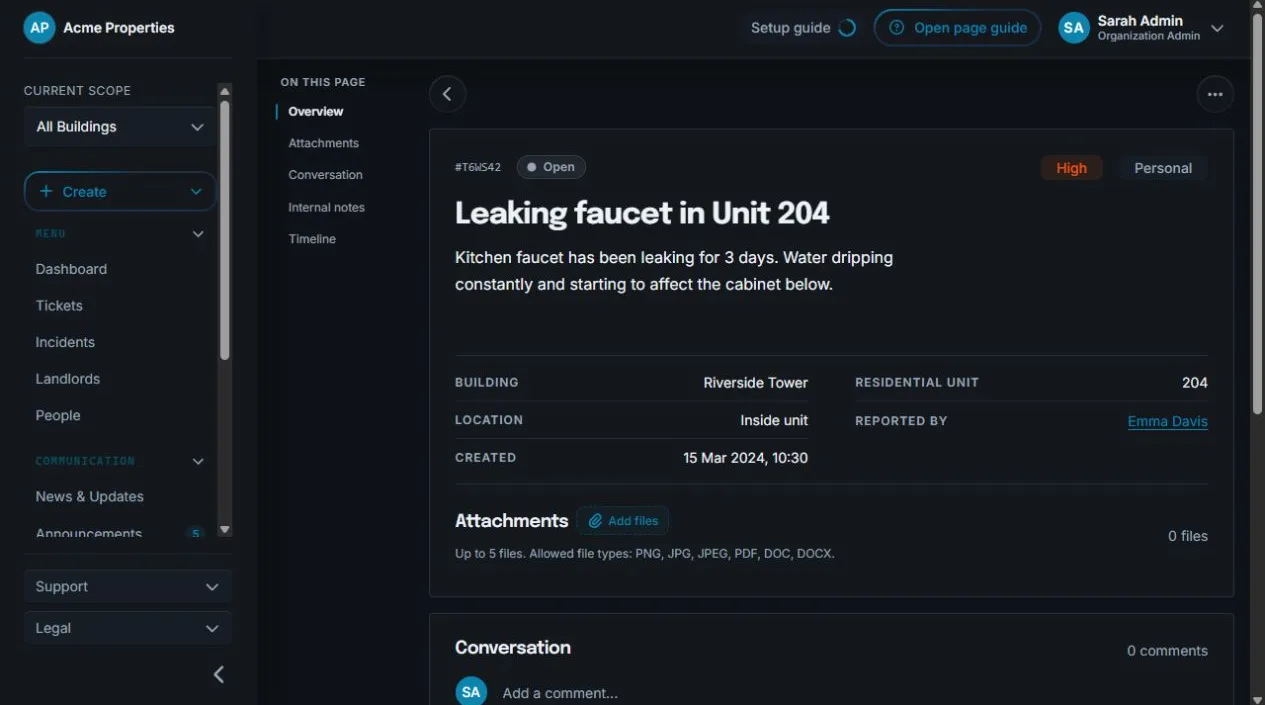
“In progress” is not a next action. A useful ticket records:
- the responsible team or building scope;
- the current status;
- what must happen next;
- who is expected to act;
- the next review or appointment date.
For example: “The housing team will ask the plumbing contractor for an appointment by Wednesday” is actionable. “Passed to maintenance” is not. If the work moves to a contractor, the next internal checkpoint should remain clear. The contractor may perform the repair, but the housing organization still controls resident communication and closure.
This is where maintenance request tracking becomes more valuable than a mailbox or spreadsheet. The process can show waiting states without losing responsibility.
5. Update the tenant before they have to chase
The most useful update answers three questions:
- What has happened since the previous message?
- What happens next?
- When should the tenant expect another update?
Even when there is no final answer, a short progress update reduces uncertainty. For example:
We have sent the photos to the plumbing contractor. We expect an appointment proposal tomorrow and will update this ticket by 16:00, even if the appointment is not confirmed yet.
Avoid promises that depend on someone else. Say what your team controls and name the next checkpoint.
6. Close the request with a useful record
Before closing, record what was done and when. Attach relevant completion evidence, note any follow-up work, and tell the tenant that the request is being closed. Give them a clear way to respond if the issue returns.
A good closure note might read:
The plumber replaced the sink trap and tested the connection on 25 August. No further leak was found. We are closing this request. Reply here if you notice new moisture under the cabinet.
This creates a service history that can help with recurring problems and future contractor conversations.
A practical repair request checklist
Before moving a ticket forward, check that it has:
- a specific problem and location;
- an appropriate priority;
- personal or building-wide scope;
- a clear responsible team or operating rule;
- one visible next action;
- a date for the next update;
- a clear resolution note before closure.
The best workflow is the smallest one your team can follow consistently. Sicket is designed to keep these requests, updates, and building communication structured without trying to become a complete property management suite. Review the Sicket product overview or schedule a demo to see how that focused workflow works.