Property operations
Observer access: read-only oversight for housing stakeholders
Learn how Sicket Observer accounts give owners, board members, auditors, and asset managers read-only oversight across assigned buildings.

Housing organizations often need to keep people informed without giving them responsibility for day-to-day operations. An owner may need a portfolio overview. A board member may need to follow building issues. An auditor may need evidence of how communication is progressing. An asset manager may need trends without access to resident administration.
Sharing exports or screenshots creates extra work and quickly becomes outdated. Giving every stakeholder a landlord or administrator account goes too far in the other direction. Those roles include operational capabilities and information that an oversight stakeholder does not need.
Sicket’s Observer role is designed for this gap. It provides read-only visibility across selected buildings while keeping operational controls and private resident information out of scope.
Who Observer access is for
Observer is suitable for stakeholders who need oversight without operational permissions, including:
- property and portfolio owners;
- board or supervisory board members;
- internal and external auditors;
- asset managers;
- other approved stakeholders who need building-level visibility.
Observer is not a resident community role or a representative role. An Observer does not speak for residents, manage a tenant group, or participate in ticket handling. It is an oversight role for reviewing selected operational information.
How building access is assigned
An organization administrator invites an Observer and assigns one or multiple buildings. Those assignments can be changed later as responsibilities, ownership, or review scopes change.
Every view remains limited to the assigned buildings. An Observer assigned to two buildings cannot use portfolio navigation or analytics to open information from a third building.
This building scope follows the same practical principle described in our guide to property communication software: each role should see what it needs to perform its purpose, rather than inheriting broad access by default.
What an Observer can see
Within assigned buildings, an Observer can review:
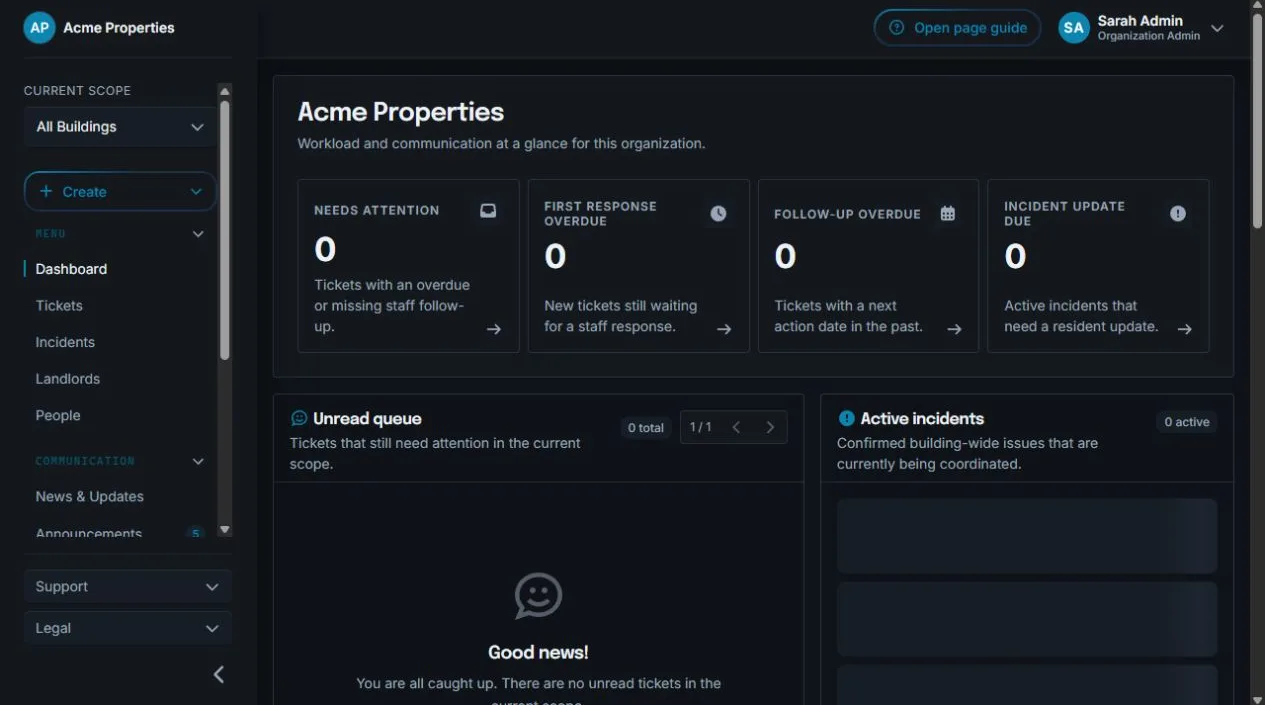
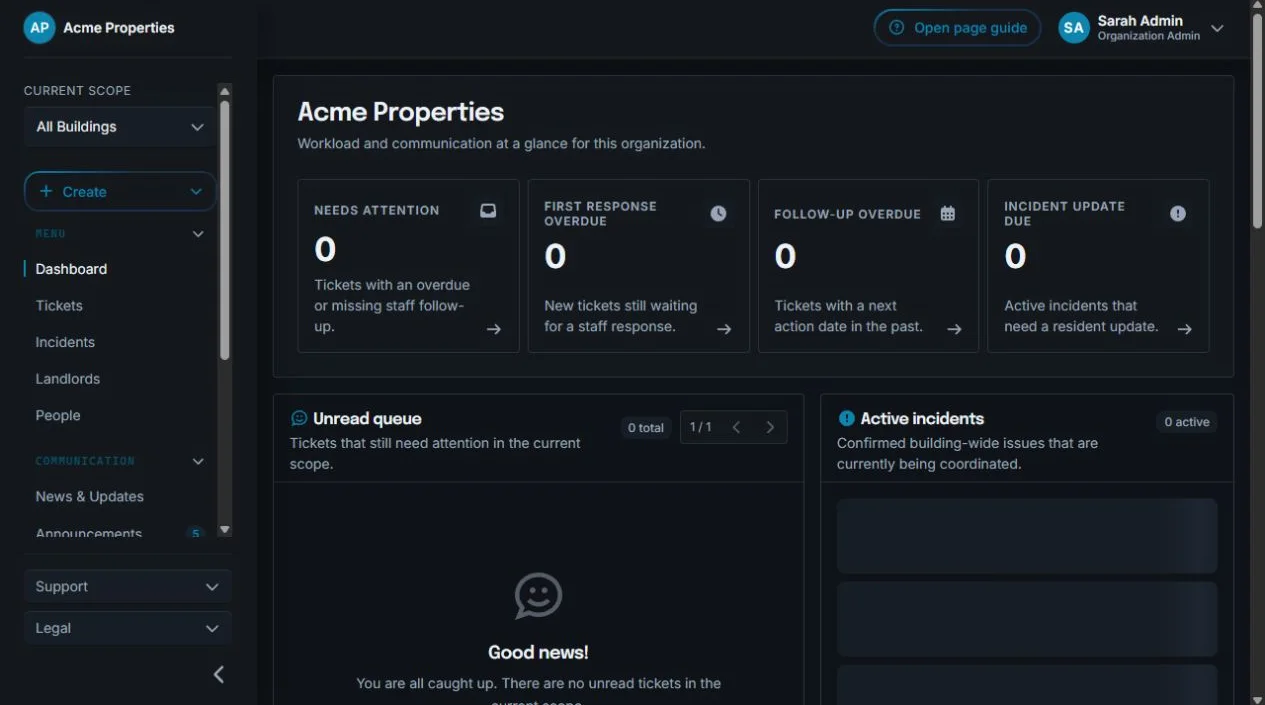
- read-only dashboard and ticket overviews;
- assigned building pages;
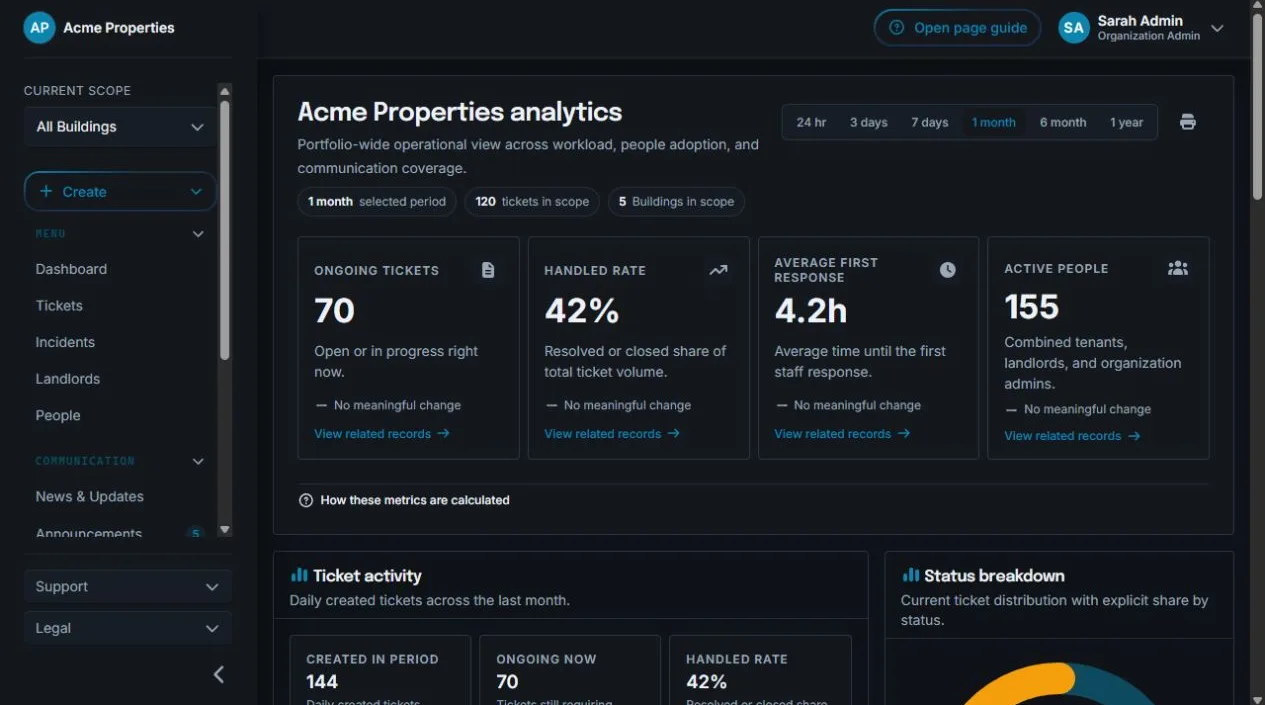
- aggregate building analytics across the Observer’s assigned scope;
- published News & Updates;
- published announcements;
- active incidents that are visible to residents.
This gives a stakeholder enough context to understand ticket volume, building issues, resident-facing communication, and operational trends. It does not turn the Observer into a ticket owner or communication publisher.
Read-only means no operational actions
Observers cannot create, edit, delete, comment on, publish, invite, or manage records. They cannot assign work, change ticket status, update an incident, send an announcement, or alter building access.
Observer accounts also do not receive the operational or ticket-management email routing used for landlords. Oversight remains separate from the notifications and responsibilities of the people handling the work.
This distinction matters when comparing a focused communication layer with a broader administration suite. Sicket can provide useful operational visibility without making every stakeholder part of the active workflow. See property management software versus tenant communication software for more context on that boundary.
Privacy boundaries are part of the role
Read-only access alone is not a sufficient privacy boundary. A person who cannot edit a record could still see information that is unnecessary for oversight. Observer therefore also limits which information is visible.
Observers do not have access to:
- People, tenant, or landlord rosters;
- the identity behind an anonymous ticket;
- reporter names or residential units on personal tickets;
- internal notes;
- attachment contents;
- personal-ticket conversations;
- drafts or archived communications;
- Knowledge Base management;
- contractor cases;
- AI pattern controls or pattern history;
- billing or organization settings.
Anonymous identities are never revealed to an Observer. Personal-ticket reporter names and residential units remain hidden even when the ticket appears in a permitted overview. These restrictions reduce exposure to information that is not needed to review building-level operations.
When to use Observer instead of another role
Use Observer when someone needs to review what is happening but should not perform the work. Use a landlord or administrator role when the person must manage tickets, communicate with residents, or maintain records.
Before assigning access, define the person’s purpose and buildings. A useful review asks:
- Which buildings does this stakeholder need to oversee?
- Which resident-facing information is relevant to that purpose?
- Does the person need to take operational actions? If yes, Observer is not the right role.
- When should the assignment be reviewed or removed?
This keeps access aligned with a clear responsibility instead of using broad accounts as a convenience.
Plan availability
Observer accounts are not included in Starter. Professional includes up to 10 Observer accounts. Enterprise Observer access is configurable during the commercial rollout; Sicket does not advertise a fixed Enterprise plan limit.
Review the full Observer access and privacy overview, compare the current options in the plan comparison, or schedule a demo to discuss the buildings and stakeholders in your oversight model.